Logistics Intelligence & Updates
Expert insights, regulatory updates, and supply chain solutions from Dubai Cargo Village.
How to Ship Norwegian Salmon by Air Cargo?
Table of Contents
- Set the Cold Chain: EU Rules Keep Fresh Fish Near Melting-Ice Temperature
- Select and Trace Norwegian Salmon by Batch, Farm, and Slaughter Date
- Pre-Cool and Pack for a 0–2°C Chilled-Transport Target
- Book IATA Perishable Cargo Handling and Prepare Export Documents
- Track Temperature Through Transit and Verify the Cold Chain on Arrival
- FAQS
- Conclusion
- Related Posts
Shipping Norwegian salmon by air is a race against time, temperature, and avoidable handling delays. Norwegian Salmon Air Cargo Shipping typically begins well before the aircraft leaves: the product must be chilled, packed for its intended journey, and matched with a suitable flight plan. A fresh fillet and a frozen portion need different temperature strategies. Small details count.
The shipper should confirm the destination’s import requirements, required health documentation, airline acceptance rules, and packaging specifications before booking. Use clean, food-grade packaging with enough insulation for the route and expected delays. Refrigerants and packing methods should suit the product and carrier requirements. A temperature logger can help record conditions, though it cannot prevent a delay or fix poor packing. Choose a route with reliable connections and coordinate collection, airport handling, and final delivery so the shipment does not sit unattended on a warm loading area.
Clear labels, accurate shipment records, and timely communication help reduce confusion at each handoff. Keep the product’s temperature needs visible to everyone handling the cargo. For longer routes, ask the carrier about transit times, available temperature-controlled handling, and contingency options. These vary by airport and service; a direct flight is not automatically the safest choice if ground handling is weak. There is no single packing plan for every shipment. Test the setup on a representative route, review the temperature data, and revise it when the evidence calls for change. A small planning gap can become a costly quality problem.
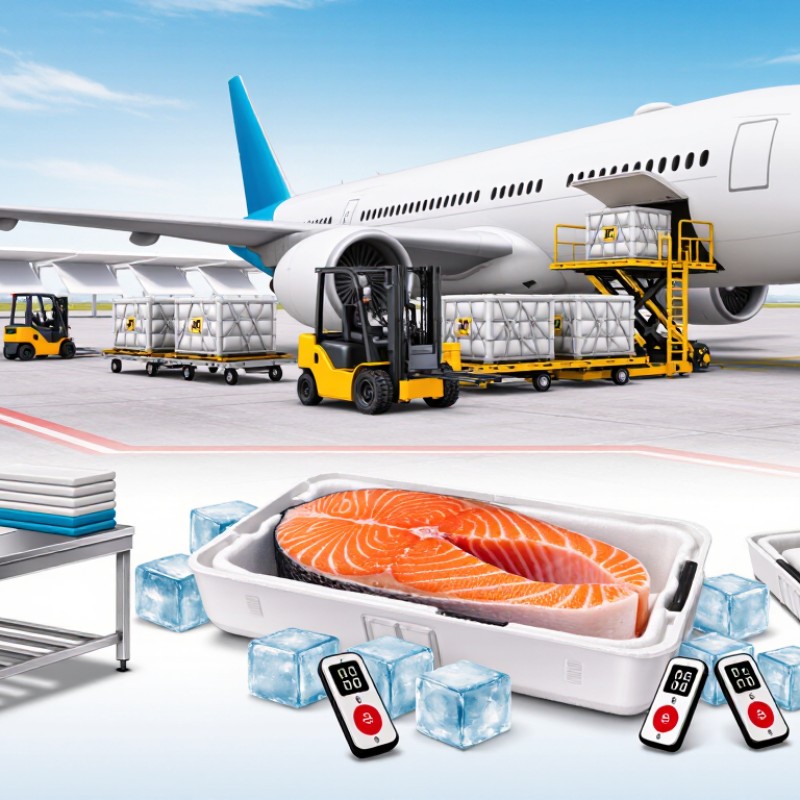
Set the Cold Chain: EU Rules Keep Fresh Fish Near Melting-Ice Temperature
Fresh Norwegian salmon travels safely only when temperature control begins before the aircraft. EU hygiene rules require fresh fishery products to be kept at a temperature approaching that of melting ice (Regulation (EC) No 853/2004). A practical operating target is 0–2°C throughout packing, road transfer, terminal storage, and loading. This is a handling target, not a replacement for the legal wording. Use clean, insulated boxes with enough ice, and keep meltwater away from the fillets. Place calibrated probes among cartons, not against a cold wall. Record product temperatures at dispatch and each handoff.
The Norwegian Seafood Council’s 2024 export statistics report roughly 1.3 million tonnes of salmon exports, showing the scale behind this trade. Airfreight shortens transit, but transfers still create warm spots: screening queues, exposed aprons, or delayed connections. Keep pallets under temperature-controlled cover and agree on a contingency plan before tendering. Check that the destination handler can receive the shipment promptly. Minutes matter. A cold outer carton does not prove the centre stayed cold. Probe representative cartons on arrival, inspect the ice, and investigate missing temperature records rather than smoothing over the gap. Cold-chain paperwork helps, but it cannot make a warm handoff safe.
How to Ship Norwegian Salmon by Air Cargo?
Set the cold chain: EU rules require fresh fish to be kept at a temperature approaching that of melting ice.
The 0°C mark is the melting-ice reference, not a precise statutory limit for fresh fish. EU rules specify that fresh fishery products must be kept at a temperature approaching it; frozen fishery products are generally kept at −18°C or colder. Source: Regulation (EC) No 853/2004, Annex III, Section VIII.
Select and Trace Norwegian Salmon by Batch, Farm, and Slaughter Date
For air cargo, salmon traceability begins before packing. Assign each lot a unique batch code linked to its farm, harvest record, and slaughter date. Norway exported about 1.26 million tonnes of salmon in 2024, according to the Norwegian Seafood Council’s export statistics. At that scale, clear lot records help buyers reconcile cartons with shipment documents. Small gaps matter.
Record the farm site, batch identity, slaughter date, packing time, and carton count in one consistent system. Keep the code readable on each carton, not only on a master pallet label. GS1’s Global Traceability Standard describes how linked event data can support product tracking across supply chains. In practice, a spreadsheet may be enough for a small shipment, but only if staff update it reliably. That assumption deserves scrutiny.
Before uplift, compare carton labels against the packing list and air waybill. Log product temperature and dispatch time, and retain the handover record. FAO’s Code of Practice for Fish and Fishery Products advises keeping chilled fish as close as possible to 0°C. A batch record cannot prove cold-chain performance by itself. Pair it with temperature checks at packing and handover, then investigate gaps rather than smoothing them over. Dates are not decoration.
Pre-Cool and Pack for a 0–2°C Chilled-Transport Target
For air shipment, the 0–2°C target starts before the salmon reaches the airport. Pre-cool the product and insulated packaging, not just the cargo area. The FAO Code of Practice for Fish and Fishery Products recommends keeping chilled products as close as possible to 0°C. A warm liner or carton can use up the temperature margin before loading. Small details matter.
Use clean, food-grade insulated boxes, chilled gel packs, and a moisture barrier. Position packs around the product without crushing the fillets. Place a calibrated probe between representative cartons, then record temperatures at packing, handover, and arrival. The FAO technical paper Quality and Quality Changes in Fresh Fish reports that spoilage can proceed about twice as fast with each 5°C temperature rise. This is a warning, not a precise shelf-life promise. Keep cartons sealed, limit staging time, and confirm that each transfer supports chilled handling. A schedule may look sound on paper, yet a ramp delay can quietly erode the cold chain. Pre-cooling helps, but it cannot fix a poor handover.
| Stage | Operating target or specification | Checks and handling actions |
|---|---|---|
| 1. Receive and inspect | Keep fresh salmon chilled; target product temperature: 0–2°C. | Check product temperature with a calibrated probe using an appropriate hygienic method. Inspect packaging, product condition, and lot identification; segregate any product outside the approved specification. |
| 2. Pre-cool before packing | Bring the salmon and pack-out area to the required chilled condition before assembling the shipment. | Do not rely on the aircraft or airport warehouse to cool warm product. Record product temperature at pack-out and minimize time out of controlled refrigeration. |
| 3. Primary packaging | Use clean, food-contact-compliant packaging suited to chilled fish and the chosen transport configuration. | Seal packs to limit leakage and contamination. Keep any meltwater contained, and use absorbent material where appropriate without obstructing drainage or compromising food safety. |
| 4. Insulated shipper and coolant | Use an insulated shipper and a validated coolant arrangement designed to maintain the product at 0–2°C for the planned journey. | Condition coolant as specified by the pack-out design. Prevent direct contact between frozen coolant and salmon unless the packaging system has been tested to avoid freezing or localized cold damage. |
| 5. Pack-out validation | Size the packaging and coolant for shipment weight, starting temperature, expected transit time, and likely handling delays. | Validate the pack-out under representative conditions before routine use. Include foreseeable dwell time at origin, transfer points, and destination rather than transit time alone. |
| 6. Temperature monitoring | Monitor the shipment against the 0–2°C product-temperature target throughout the distribution plan. | Place a suitable temperature logger within the shipment according to the validated packing configuration. Review the temperature record on arrival and document any excursion for assessment. |
| 7. Air-cargo booking and handoff | Book chilled handling appropriate to the shipment; do not assume all aircraft holds or airport facilities maintain 0–2°C. | Confirm temperature-handling capability, acceptance requirements, cut-off times, and transfer arrangements with the carrier and handling agents. Keep the shipment protected from avoidable exposure to ambient conditions. |
| 8. Labels and shipment documents | Identify the shipment as perishable chilled fish and state the required handling and temperature instructions clearly. | Use the required export, health, customs, and air-cargo documents for the route and destination. Ensure package markings and documentation match the consignment details. |
| 9. Arrival and acceptance | Maintain chilled conditions during collection and onward delivery; check the product promptly on receipt. | Record arrival time, package condition, and product temperature. Compare logger data with the shipment specification and follow the receiver’s documented procedure for temperature deviations. |
Book IATA Perishable Cargo Handling and Prepare Export Documents
Book air capacity before packing the salmon, and identify it as fresh, chilled seafood. Give the carrier exact carton dimensions, gross weight, piece count, required temperature range, and ready time. Confirm cut-off times and any transfer points; a short connection can still involve warm handling areas. IATA perishable-cargo procedures help define handling expectations, but confirm the carrier’s current acceptance rules for the route. Keep the product within its specified temperature range, using insulated, leak-resistant packaging and a suitable temperature logger. Small gaps matter. A booking confirmation alone does not guarantee careful handling.
Prepare export papers with matching product descriptions, weights, carton counts, and lot references. Typical documents include a commercial invoice, packing list, air waybill, and export declaration. Norwegian salmon may also need an official health certificate and documents required by the destination country. Check these requirements with the relevant authorities and your freight forwarder before dispatch; they can vary by market. Keep copies accessible, not only inside the shipment pouch. One easy detail to miss is a mismatch between the invoice weight and the packing list. Review the final set against the packed cartons, then check the temperature record after handover. A printed target is not proof that the cold chain stayed intact.
Track Temperature Through Transit and Verify the Cold Chain on Arrival
Norwegian salmon should travel chilled, not merely be labeled “perishable.” Agree on a product-specific temperature target with the shipper and receiver; chilled Atlantic salmon is commonly kept close to 0–2°C. A cargo-hold setting does not prove the fish itself stayed within range. Place calibrated data loggers among representative cartons, including positions near doors or transfer points, and record temperatures at regular intervals. Keep the logger serial numbers and calibration dates with the shipment documents. Small details matter.
FAO’s The State of Food and Agriculture 2019 estimated that 14% of food is lost between harvest and retail. That figure covers many foods, not salmon alone, but it shows why temperature records deserve attention. IATA’s 2024 air cargo market analysis reported an 11.3% year-on-year rise in full-year cargo demand, making handoffs and delays worth checking closely. On arrival, compare logger records with flight and transfer times, inspect carton condition, and measure representative product temperatures with a calibrated probe. A smooth average can hide a brief warm excursion. One logger can also miss a warm corner. I would not accept an intact-looking box as proof of an intact cold chain; review the data, investigate gaps, and document any uncertainty before release.
FAQS
Use 0–2°C as a practical chilled-transport target. Fresh fish should remain near melting-ice temperature. The target does not replace applicable requirements.
Before airport delivery. Pre-cool the salmon and insulated packaging, then keep the cartons chilled during road transfer, storage, and loading.
Place a calibrated probe between representative cartons, not against a cold wall. Record readings at packing, dispatch, handover, and arrival.
Use clean, food-grade insulated boxes, chilled packs, and a moisture barrier. Keep meltwater away from the fish. Avoid crushing the fillets.
Screening queues, exposed loading areas, and delayed connections can create warm spots. Keep pallets under temperature-controlled cover. Minutes matter.
Probe representative cartons and inspect the ice and temperature records. A cold outer carton does not prove the centre stayed cold.
Confirm capacity, carton dimensions, gross weight, piece count, temperature needs, ready time, and cut-off times. Ask how transfer points are handled.
Common documents include an invoice, packing list, air waybill, and export declaration. Health certificates or destination-specific papers may also be required. Check weights and carton counts carefully; mismatches are easy to miss.
No. Agree on a contingency plan and confirm that the destination handler can receive the shipment promptly. Paperwork helps, but it cannot fix a warm handoff.
Conclusion
Norwegian Salmon Air Cargo Shipping depends on maintaining a reliable cold chain from the moment the fish is selected until it reaches its destination. Begin by identifying each batch and recording its farm and slaughter date, so the product can be traced throughout transport. Fresh salmon should be handled carefully and kept close to melting-ice temperature in line with applicable food-safety requirements.
Before packing, pre-cool the fish and use suitable insulated packaging with enough cooling material to support a chilled-transport target of 0–2°C. Book the shipment as perishable cargo, confirm handling arrangements, and prepare the required export documents. During transit, monitor temperature and shipment progress, then check the salmon and review temperature records on arrival. These steps help protect freshness, support traceability, and make the air-cargo journey more dependable.

Blog Tags: