Executive Summary: Why Sourcing Directors Choose DCV Bonded Warehousing
In global supply chain management, working capital velocity and regulatory speed dictate competitive survival. Standard free zone warehousing requires secondary transit legs, whereas Bonded Warehousing at Dubai Cargo Village (DCV) provides direct physical adjacency to Dubai International Airport (DXB) flight aprons. Under Common GCC Customs Law (FCIC Article 89) and Dubai Customs Notice No. 5/2020, storing inventory under a bonded status suspends the standard 5% customs import tariff and 5% Value Added Tax (VAT) indefinitely until goods enter mainland commercial trade.
For international traders routing high-value electronics, pharmaceuticals, perishables, and luxury goods between Europe, Asia, Africa, and the Americas, DCV bonded facilities function as an agile operational tax shelter and high-velocity transshipment engine.
1. The Architecture of Bonded Warehousing at Dubai Cargo Village
Dubai Cargo Village (DCV), established as the primary air cargo infrastructure for Dubai International Airport (DXB), stands as one of the world's most sophisticated logistics hubs. When global enterprises inquire about Bonded Warehousing Dubai Cargo Village, they are seeking more than simple pallet storage—they require an integrated customs-controlled physical enclosure where cargo maintains an "in-transit" international status.
Unlike non-bonded mainland facilities where goods cleared through customs incur immediate tax liabilities, a customs bonded warehouse operating within the Dubai Airport Free Zone (DAFZA) / DCV jurisdiction operates under direct supervision of Dubai Customs. This infrastructure provides three structural advantages:
- Duty & Tax Deferral: Import tariffs (5% base rate) and 5% UAE VAT are suspended during the entire duration of storage. Cash flow remains within the enterprise rather than locked in pre-paid customs duties.
- Zero Duty on Strategic Re-Export: When merchandise stored in DCV bonded storage is subsequently shipped out to foreign markets (such as Saudi Arabia, Qatar, Indonesia, the UK, or North Africa) under Mirsal II Code 301, zero customs duty is assessed.
- Airside Speed & Zero Inter-Facility Latency: Located meters from DXB cargo aprons, inbound airfreight can be transferred directly to bonded storage under Code 201 (In-Bond Transfer) within 2 to 4 hours of aircraft touchdown, avoiding standard customs inspections and off-site trucking delays.
2. Comprehensive Product Recommendations: Enterprise Bonded Warehousing Solutions
At UKF Services, operating directly from Office No. 2056-A, First Floor, Entrance No. 4, Dubai Cargo Village since 2008, we provide tailored bonded storage architectures designed around specific commodity requirements and compliance frameworks:
1. GDP Cold-Chain & Perishable Bonded Storage
Specialized temperature-controlled zones (+2°C to +8°C, +15°C to +25°C ambient, and -20°C deep freeze) meeting strict Good Distribution Practice (GDP) standards. Essential for Norwegian fresh salmon, biopharmaceuticals, and high-value food commodities entering GCC trade lanes.
2. High-Value Secure Bonded Storage
Reinforced vault facilities equipped with 24/7 dual-authentication biometric controls and infrared tracking. Built specifically for precious metals (gold bullion), high-end electronics, luxury watches, and high-security defense equipment in transit.
3. Re-Export Consolidation & Cross-Docking Zone
Rapid sorting, palletization, and containerization of multi-origin air freight into outbound FCL sea containers or cross-border GCC trucks, fully maintaining bonded status across multi-modal legs.
4. Bonded Value-Added Services (VAS) Facility
Dedicated processing cleanrooms inside the bonded enclosure for non-transformative re-labeling, product kitting, GSO barcode application, and custom packaging prior to regional market distribution.

Optimize Your Working Capital with DCV Bonded Storage
Speak with our senior customs compliance specialists at Dubai Cargo Village today to compute your exact duty deferral savings.
Get a Quote3. Comparative Analysis: Bonded Storage vs. Free Zone vs. Mainland Warehousing
Global procurement leaders often evaluate whether to store inventory in a Dubai Cargo Village bonded facility, a JAFZA Free Zone warehouse, or a mainland Dubai facility. The table below illustrates the technical and fiscal differences:
| Parameter | DCV Bonded Warehouse (UKF) | JAFZA Free Zone Warehouse | Dubai Mainland Facility |
|---|---|---|---|
| Primary Location | Airside Dubai Airport (DXB) | Jebel Ali Port / Seaport Zone | Mainland Industrial Areas |
| Upfront Duty & VAT | 0% (Suspended) | 0% (Suspended) | 10% Payable Immediately (5% Tariff + 5% VAT) |
| Inbound Air Cargo Clearance | Immediate (2–4 Hours via Code 201) | Requires Bonded Truck Transit (12–24h) | Standard Clear & Pay (6–12h) |
| Emergency Transshipment Speed | Ultra-Fast (Direct Runway Load) | Moderate (Requires Port Clearance) | Slow (Customs Clearance Mandatory) |
| Best For | Air Freight, High-Value, Perishables, Fast Re-Export | Bulk Ocean Freight (FCL), Long-term Heavy Goods | Domestic UAE Retail Distribution |
4. Future Procurement Trends in Bonded Logistics (2026–2030 Horizon)
The global supply chain landscape is shifting rapidly under the influence of geopolitics, trade agreement expansions, and artificial intelligence. Global buyers evaluating bonded warehousing in Dubai Cargo Village must align their procurement strategies with four key emerging trends:
Trend 1: AI Intent-Driven Buffer Stock & Dynamic Re-Routing
Supply chain management is moving from reactive warehousing to predictive inventory placement. Multinational corporations are leveraging AI forecasting models to store un-cleared buffer stock in Dubai Cargo Village. Because DCV sits at the crossroads of Europe, Asia, and Africa, holding un-dutiable stock at DXB allows companies to fulfill sudden demand spikes in London, Riyadh, or Singapore within 24 hours via air express, without committing to local country import taxes in advance.
Trend 2: Expansion of Comprehensive Economic Partnership Agreements (CEPAs)
The UAE’s aggressive rollout of bilateral CEPA agreements (including India, Indonesia, Turkey, South Korea, and East African nations) has transformed Dubai into a global re-export clearing house. Global sourcing directors use UKF’s bonded storage at DCV to accumulate products originating from non-CEPA countries, perform compliant origin verification, and re-export them seamlessly under preferential tariff documentation.
Trend 3: Multi-Modal Sea-Air & Air-Sea Intermodality
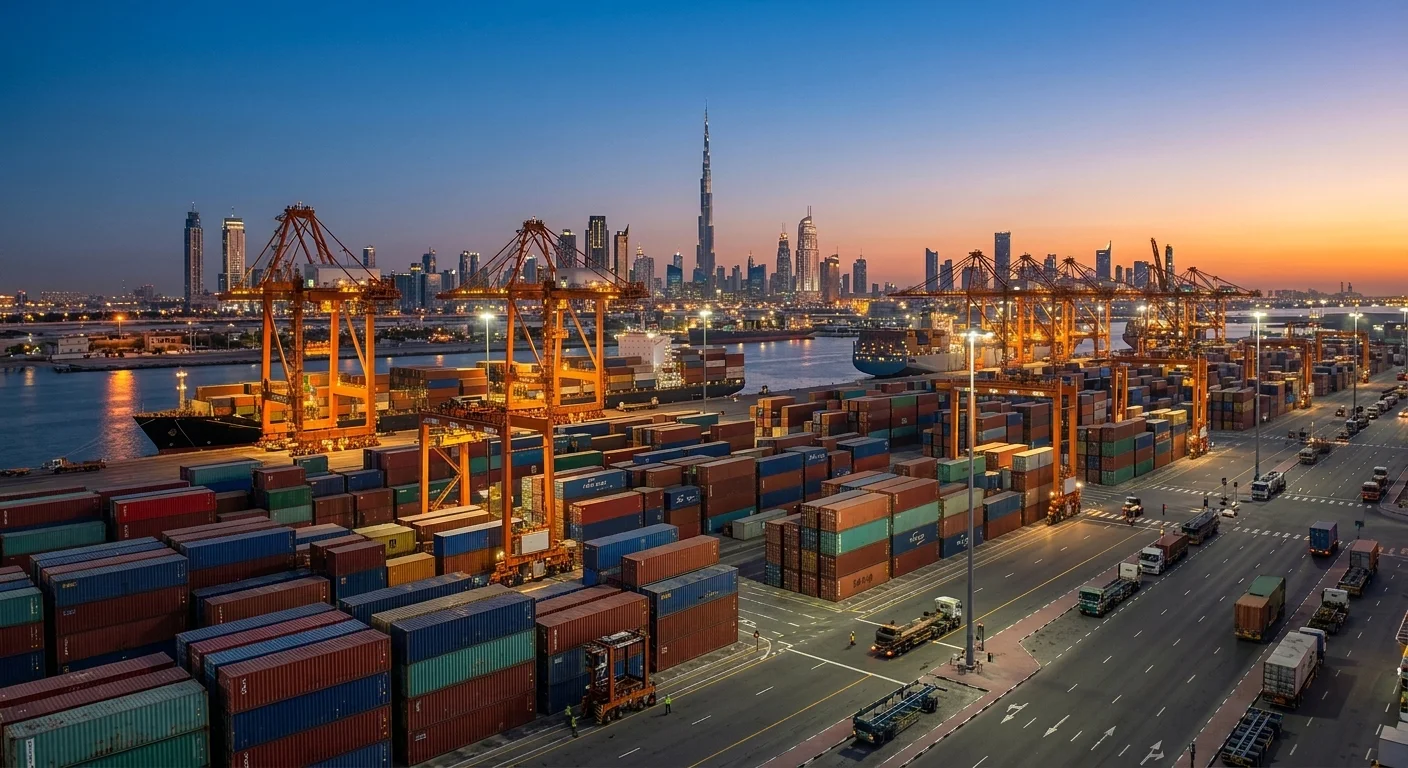
Navigating global maritime disruptions (such as Red Sea vessel diversions around the Cape of Good Hope) requires adaptive intermodality. Sourcing directors ship bulk ocean freight into Jebel Ali Port, move it under customs bond to Dubai Cargo Village via bonded road corridors, store it in DCV bonded warehouse, and dispatch emergency air freight consignments worldwide to preserve production schedules.
5. Step-by-Step Operational Workflow: Depositing & Clearing Cargo at DCV Bonded Warehouse
To ensure total transparency and E-E-A-T operational standards, UKF Services executes bonded warehousing movements through a strict 5-stage customs compliance protocol:
- Stage 1: Pre-Arrival Manifest & Documentation Audit
Prior to flight touchdown at DXB, UKF’s customs brokerage team reviews the Master Air Waybill (MAWB), Commercial Invoice, and Packing List to verify commodity code accuracy under the Harmonized System (HS Code). - Stage 2: Mirsal II Customs Declaration Filing (Code 201)
Our team files a formal In-Bond Transfer Declaration in the Dubai Customs Mirsal II system, establishing a legal customs guarantee that covers duty obligations while cargo moves airside. - Stage 3: Airside Apron Transfer & Bonded Intake
Goods are received directly from the dnata/Emirates SkyCargo terminal into UKF’s designated bonded facility within Dubai Cargo Village. Barcode tracking records physical location and serial numbers. - Stage 4: Value-Added Processing & Inventory Management
While in bonded status, goods undergo quality control, GSO re-labeling, or cargo re-consolidation. Stock levels are visible via real-time inventory reporting. - Stage 5: Final Dispatch (Mainland Clearance or Re-Export)
Goods leave the bonded warehouse under one of two options:- Option A (Re-Export - Code 301): Cargo is loaded onto outbound aircraft or GCC trucks. Customs bond is discharged; 0% duty/VAT paid.
- Option B (Mainland Entry - Code 101): Duty (5%) and VAT (5%) are declared and paid only on the exact quantities released into the domestic UAE market.