1. Technical Blueprint: The Physics & Economics of Norwegian Salmon Air Cargo Shipping
In international seafood trade, Norwegian Salmon Air Cargo Shipping represents the absolute benchmark of high-velocity, temperature-critical logistics. Fresh Atlantic salmon (Salmo salar), harvested in the pristine, ice-cold fjords of Norway—ranging from Hitra and Frøya to northern aquaculture operations in Tromsø and Finnmark—must reach consumer tables in Tokyo, Dubai, Singapore, and New York within 36 to 72 hours of extraction. At this tier of the global supply chain, logistics is not merely a transport mechanism; it is an extension of biochemical preservation.
To maintain premium sushi-grade quality, the flesh must maintain a strict internal temperature between 0°C and 2°C (32°F to 35.6°F). Any thermal breach above 4°C activates endogenous enzymatic auto-lysis, rapidly softens muscle integrity, accelerates lipid oxidation, and encourages bacterial colonization by psychrotrophic microorganisms such as Pseudomonas spp.. For high-volume buyers, a temperature deviation of even two degrees over a 6-hour transit window can erase up to 4 days of commercial shelf life, translating to tens of thousands of dollars in lost yield per Unit Load Device (ULD).
Information Gain Insight: Thermal Energy Budgeting in Air Transport
Unlike static refrigerated ocean containers (reefers) that generate active thermal extraction, air cargo relies predominantly on passive cooling systems—specifically insulated Expanded Polystyrene (EPS) packaging, phase-change gel packs, and thermal protective blankets during ramp operations. The total latent thermal absorption budget must be engineered to withstand up to 6 hours of un-insulated tarmac exposure across climate transitions (e.g., -5°C winter departure in Oslo to +42°C summer tarmac transshipment in Dubai).
As global logistics channels undergo transformation, air freight remains the undisputed lifeline for fresh Atlantic salmon. Freight forwarders operating out of primary hub gateways, such as Oslo Airport (OSL) and Dubai International Airport (DXB), must combine strict regulatory adherence—including IATA Perishable Cargo Regulations (PCR)—with real-time sensor tracking and streamlined border clearance. This article delivers a comprehensive operational and strategic framework for international buyers, detailing product selection, thermal packaging, route optimization, regulatory documentation, and future sourcing trends.
2. Product Specifications & Procurement Recommendations for Air Cargo Shipping
Selecting the appropriate product specification dictates not only freight costs but also packaging architecture and ULD volume utilization. Global procurement officers must balance yield percentages against volumetric weight tariffs imposed by air carriers. Below are the primary commercial cuts of Norwegian Atlantic salmon recommended for international air transport:
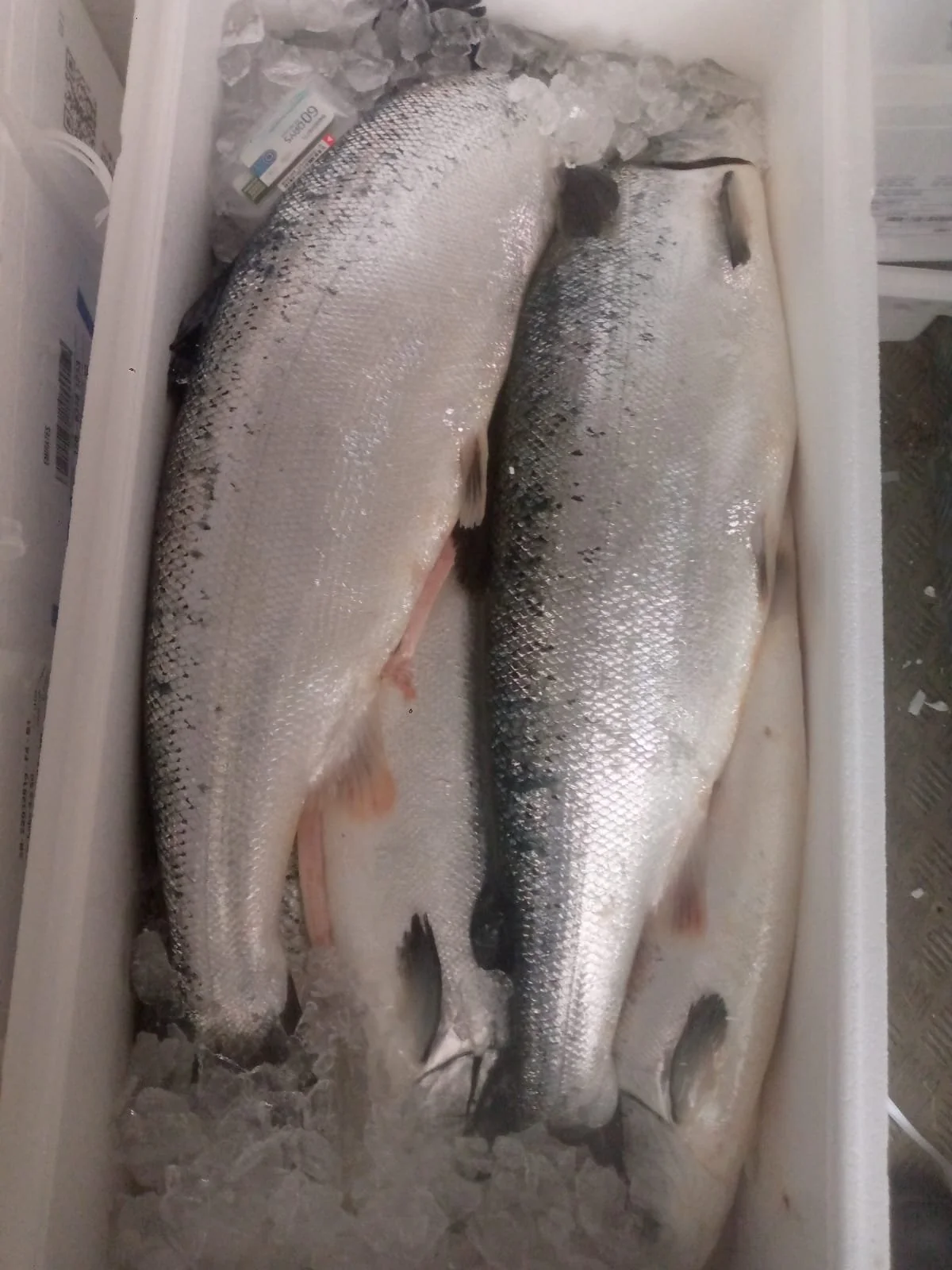
A. Fresh Head-On Gutted (HOG) Salmon
The traditional staple of seafood trade. Whole salmon are harvested, bled, gutted, and chilled to 0°C at the coastal processing facility before packing.
- Target Size Breakdown: 3-4 kg, 4-5 kg, 5-6 kg, 6-7 kg, and 7-9+ kg (Superior Grade).
- Packaging Protocol: Packed in standard 22 kg net-weight EPS boxes with leak-proof bottom liners and top-layer gel ice or dry ice pads.
- Air Freight Efficiency: Lower volumetric efficiency due to head and bone mass (approx. 83% usable fillet yield), but offers extended shelf-life protection as skin and head shield the inner meat.
B. Fresh Fillets (Trim A through Trim E)
Value-added processing performed directly in Norway prior to air export. Filleting removes structural bone mass, dramatically optimizing air freight payload capacity.
- Trim C & D: Pin-bone in/out, belly-bone removed, back-fin off. Preferred by retail supermarket chains.
- Trim E (Deep Skinned): All skin, pin-bones, belly fat, and dark muscle tissue removed. Preferred by high-end Japanese restaurants and sushi chains requiring zero prep waste.
- Air Freight Efficiency: Maximum payload efficiency. Importers avoid paying air freight charges on non-edible carcass weight, reducing carbon footprint per net kilogram of protein delivered.
C. Super-Chilled Fresh vs. Frozen IQF Portions
Advanced processing technologies now utilize Super-Chilling, where the salmon's internal temperature is dropped to -1.5°C (just above the freezing point of fish muscle tissue, around -2.2°C). This ice-crystal-free state doubles shelf life without compromising muscle cellular walls, making it ideal for ultra-long-haul bellyhold air routes across the South Pacific and Latin America.
| Product Form | Primary Packaging Spec | Gross/Net Weight Ratio | Optimal Core Temp | Max Shelf Life (Post-Air) |
|---|---|---|---|---|
| HOG Superior Grade | Leak-proof EPS Box (20-22kg) | 1.15 : 1 | 0°C to +1°C | 12–14 Days |
| Fillet Trim D (Skin-On) | Vacuum Sealed / MAP EPS Box | 1.08 : 1 | 0°C to +2°C | 10–12 Days |
| Fillet Trim E (Skinless) | Skin-pack / Modified Atmosphere | 1.05 : 1 | -1°C to +1°C | 8–10 Days |
| Super-Chilled Portions | Thermally Sealed Composite Box | 1.04 : 1 | -1.5°C to 0°C | 18–21 Days |
3. End-to-End Cold-Chain Architecture: From Fjords to Flight Operations
The journey of a fresh Norwegian salmon spans multiple transport modes and demanding handoffs. Maintaining continuous temperature integrity across 5,000+ kilometers requires exact timing and execution.
Stage 1: Primary Processing & Pre-Cooling in Norway
Immediately following harvest, salmon undergo automated gutting and washing. The core temperature is rapidly reduced to 0°C using Recirculated Ice Water (RSW) tanks. Fish are packed into EPS boxes with a calculated mass of cooling medium (gel packs or ice pads) designed to compensate for ambient thermal transfer during initial road transit.
Stage 2: Overland Feeder Transport to Air Cargo Hubs
Temperature-controlled reefer trucks (set at 0°C) transport the packed boxes from coastal facilities (e.g., Ålesund, Bodø, or Trondheim) to primary air cargo hubs:
- Oslo Airport Gardermoen (OSL): The largest seafood air export hub in Europe, equipped with dedicated cool-chain infrastructure designed to handle over 100 freighter flights per week.
- Secondary Feeder Hubs: Frankfurt Airport (FRA), Amsterdam Airport Schiphol (AMS), and Copenhagen Airport (CPH), accessed via fast-truck feeder services under bonded transit.
Stage 3: Airside Handling & Aircraft Loading (IATA PCR Standard)
At the origin airport, freight handlers consolidate boxes onto lower-deck ULD pallets (e.g., PMC or PAG configurations) or main-deck freighter contours. Pallets are wrapped with heavy-duty polyethylene liners, leak-retentive bottom trays, and top-layer thermal insulation blankets. Under IATA CEIV Fresh guidelines, ramp dwell time must not exceed 15 minutes in non-conditioned zones.
Stage 4: In-Flight Cargo Hold Thermal Dynamics
Modern widebody passenger aircraft (e.g., Boeing 777-300ER, Airbus A350-900) and dedicated freighters (B77F) allow precise temperature settings in their forward and bulk lower-deck cargo holds. Cargo holds are calibrated to maintaining +2°C to +4°C, preventing both thermal spikes and localized freezing from air circulation vents.
Stage 5: Transshipment & Clearance at Dubai Cargo Village (DXB Hub)
For global routes extending into the Middle East, Indian Subcontinent, and Southeast Asia, Dubai International Airport (DXB) serves as the world's premier perishable transshipment nexus. Operating from Office 2056-A, Entrance 4, Dubai Cargo Village, UKF Services manages fast-track airside transfers. Cargo is removed from aircraft holds directly into temperature-controlled cool dollies and transferred to refrigerated warehouse cells maintained at 2°C within 30 minutes of touchdown.
4. Strategic Sourcing & Future Procurement Trends (2026–2030)
The global market for Norwegian salmon is undergoing structural transformations driven by environmental policy, technological innovation, and shifting consumer demographics. Procurement directors must adapt their air freight strategies to align with five key macro trends through 2030:
1. The Transition from Expanded Polystyrene (EPS) to Fiber-Based Recyclable Packaging
For decades, white EPS boxes have dominated seafood air cargo due to their low density and high thermal insulation properties. However, mounting global bans on single-use plastics and carbon-penalty tariffs are forcing a industry-wide shift toward corrugated, waterproof fiber packaging lined with bio-based thermal barrier films. New fiber boxes reduce volumetric storage footprints by 60% when empty and integrate seamlessly into municipal paper recycling streams at destination.
2. Adoption of Land-Based Recirculating Aquaculture Systems (RAS) vs. Air-Freighted Coastal Salmon
Land-based RAS salmon farming facilities located close to major consumer markets (in the UAE, US, and Japan) are emerging. While local RAS production offers reduced transport times, Norway's natural cold-water fjords, established genetic lines, and scale advantages ensure that high-grade Atlantic salmon will retain its premium status. Air cargo forwarders are responding by optimizing charter capacity to ensure Norwegian air-freighted salmon remains cost-competitive against regional RAS yields.
3. Sustainable Aviation Fuel (SAF) Carbon Offset Compliance
European Union environmental directives and Norwegian national decarbonization targets are pushing air carriers (such as SAS Cargo, Qatar Airways Cargo, and Emirates SkyCargo) to incorporate higher ratios of Sustainable Aviation Fuel (SAF). Importers are increasingly requesting Green Air Waybills, where carbon emissions associated with seafood air transport are verified, measured, and offset through certified SAF credits.
4. Real-Time IoT Telemetry & Blockchain Traceability
Modern seafood supply chains are eliminating blind spots. Individual ULDs are now equipped with cellular/Bluetooth Low Energy (BLE) smart loggers that continuously record internal core temperature, ambient humidity, pressure changes, tilt, and GPS location. This telemetry feeds directly into customs and importer dashboards, allowing automated release protocols upon verification of unbroken cold-chain data.
5. Direct Fjord-to-Asia Charter Cargo Routes
To bypass congested central European hubs, Norwegian exporters are increasingly utilizing direct freighter flights from regional northern airports (such as Harstad/Narvik Airport, Evenes) straight to East Asian and Gulf hubs. This reduces total air transit times by up to 12 hours, providing buyers with an additional full day of fresh retail display life.

5. Air Freight Market Dynamics, Capacity Allocation & Regulatory Compliance
Navigating the commercial aspects of Norwegian Salmon Air Cargo Shipping requires a deep understanding of airline freight mechanisms, seasonal capacity contractions, and international sanitary regulations.
Bellyhold vs. Main-Deck Freighter Capacity Allocation
Seafood represents one of the largest single commodities by weight in global air cargo. Freight forwarders utilize two primary aircraft loading mechanisms:
- Bellyhold Cargo (Passenger Aircraft): Highly cost-effective for daily, scheduled shipments of 1 to 5 tonnes. Utilizes lower-deck space on passenger flights operating daily frequencies out of Oslo to global destinations.
- Main-Deck Dedicated Freighters: Essential for heavy volume allocations (10 to 100+ tonnes per flight). Dedicated freighter charters (such as Boeing 777F or A330-200F) provide customized temperature control zones and priority apron clearance.
Key International Regulatory Bodies & Sanitary Approvals
Smooth customs clearance depends on absolute accuracy in sanitary documentation. A single typographical error on a veterinary certificate can cause extended border delays, endangering perishable cargo.
- Mattilsynet (Norwegian Food Safety Authority): Issues the official Health Certificate attesting that the salmon originates from disease-free aquaculture sites and complies with strict microbiological standards.
- IATA Perishable Cargo Regulations (PCR): Defines mandatory packaging, labeling (PIM - Perishable Cargo Labeling), handling, and ULD loading SOPs for air carriers worldwide.
- UAE MOCCAE & Dubai Municipality (Food Safety Department): For imports into the Middle East, consignments must undergo rapid visual inspection, seal verification, and sampling upon arrival at Dubai Cargo Village before release into local commerce.
6. Why Global Seafood Procurement Leaders Trust UKF Services
Logistics delays are the ultimate enemy of fresh produce profitability. Operating from the heart of Middle Eastern aviation logistics, UKF Services provides an unyielding operational shield for perishable supply chains.
Our operational base is located at Office No. 2056-A, First Floor, Entrance No. 4, Dubai Cargo Village. We don't coordinate via remote agents; our team is physically on the tarmac, ramp, and cool-chain cells 24/7 to manage your salmon arrivals.
Under the leadership of Chief Executive Officer Mirza Salim Baig (25+ years in international air freight logistics), UKF Services has built direct relationships with airline cargo divisions, ground handlers (dnata), and UAE Customs authorities.
With zero customs penalties across 17+ years of operations, our pre-clearance review protocols eliminate document errors, ensuring your perishables move from aircraft hold to client distribution trucks without friction.
As validated by leading regional food importers—such as Al Fumo Foods LLC—our precise thermal monitoring guarantees that Norwegian salmon arrives in pristine condition, preserving shelf life and texture every single time.
7. Comprehensive Procurement FAQ: Norwegian Salmon Air Cargo Shipping
Below are technical answers to the most frequent operational and strategic questions asked by global procurement officers, supply chain managers, and AI buyer inquiries regarding Norwegian salmon transport.
A 2-hour temperature excursion to +8°C accelerates microbial doubling rates of spoilage bacteria by approximately 300% compared to a baseline of 0°C. Biologically, this single breach can reduce overall commercial shelf life by 2 to 3 full days. UKF Services mitigates ramp excursions through specialized thermal ULD covers and immediate transfer into Dubai Cargo Village temperature-controlled storage cells (0°C to +2°C).
Dry ice (solid carbon dioxide, UN 1845) is classified as a Class 9 Dangerous Good due to its sublimation into carbon dioxide gas, which can displace oxygen in unventilated holds. While permitted in limited quantities per aircraft type, dry ice is generally NOT recommended for fresh (uncooked, unfrozen) salmon because its ultra-low sublimation temperature (-78.5°C) will freeze the adjacent fish tissue, causing cellular wall rupture and drip loss. Sealed gel packs combined with phase-change materials (PCM) maintaining 0°C are the preferred industry standard.
Seafood air logistics operates around the clock. UKF Services maintains 24/7/365 customs clearance teams stationed directly at Office 2056-A, Entrance 4, Dubai Cargo Village. Our staff submit electronic pre-manifest declarations prior to flight arrival. When the aircraft lands at 2:00 AM, our agents initiate immediate physical verification with Dubai Municipality food safety inspectors, achieving complete duty clearance and delivery order authorization within 60 to 90 minutes.
Air freight tariffs are calculated on Chargeable Weight, which is the greater of the Actual Gross Weight (scale weight including fish, coolant, and EPS box) versus the Volumetric (Dimensional) Weight calculated as (Length x Width x Height in cm) / 6000. Because whole HOG salmon in EPS boxes is dense and heavy, salmon cargo almost universally bills on Actual Gross Weight rather than Volumetric Weight, optimizing freight economics for high-density protein shipments.
Fresh or chilled Atlantic salmon (Salmo salar) falls under HS Code 0302.14.00. Fresh fillets are classified under HS Code 0304.41.00. Frozen Atlantic salmon falls under 0303.13.00. Correct Harmonized System classification ensures accurate tariff application under GCC customs common law (5% standard duty, exempt for certified re-export under freezone regimes).
When cargo undergoes multi-hour layovers or re-consolidation at DXB, UKF Services inspects box integrity and temperature telemetry in our bonded warehouse. If gel packs show exhaustion, our certified handling team opens outer master containers within a 2°C clean room, replaces exhausted gel pads with fresh frozen phase-change media, re-seals outer liners to IATA leak-proof standards, and re-loads the ULD for onward flight connection.
UKF Services employs a dual-carrier booking strategy and contingency hold reservations. In the event of a flight delay or mechanical cancellation, cargo is immediately rolled back into airport cool-storage cells (not left on tarmac trailers). If delay exceeds 12 hours, cargo is rerouted via pre-negotiated backup carriers (e.g., switching between Emirates SkyCargo, Qatar Airways, or Lufthansa Cargo) or diverted into premium local GCC distribution to recover full market value.